
The Rise, Fall, and Comeback of the Hard Drive
The price of one terabyte of hard-drive storage in 1956, inflation-adjusted.
A terabyte of hard-drive storage cost $87.5 billion in 1956 and about $10 today. The arc of the spinning disk, told by the numbers, with every figure traced to a named source.

Placeholder entry. This file exists to demonstrate the story template and is rendered with synthetic copy. The real first article — The Rise, Fall, and Comeback of the Hard Drive — ships from the editorial pipeline once the episode is locked. The number above is the real hook; the body below is illustrative.
When IBM announced the 350 RAMAC in 1956, one of the first commercially produced hard drives, the price for a system that stored about five megabytes was roughly fifty thousand dollars a year on lease. Adjust for inflation, scale up to a terabyte, and the headline number lands where this article opens: about eighty-seven and a half billion dollars per terabyte. The figure is what gets the reader to blink. The arc of why it fell from there is the story.
How the cost fell, in three steps
The cost curve does not bend smoothly. It bends in three distinct mechanical steps: the move from oxide-coated aluminium platters to thin-film media in the late 1980s, the introduction of giant magnetoresistive (GMR) read heads in 1997, and the shift to perpendicular magnetic recording in the mid-2000s. Each step rearranged what was possible inside the same physical envelope.
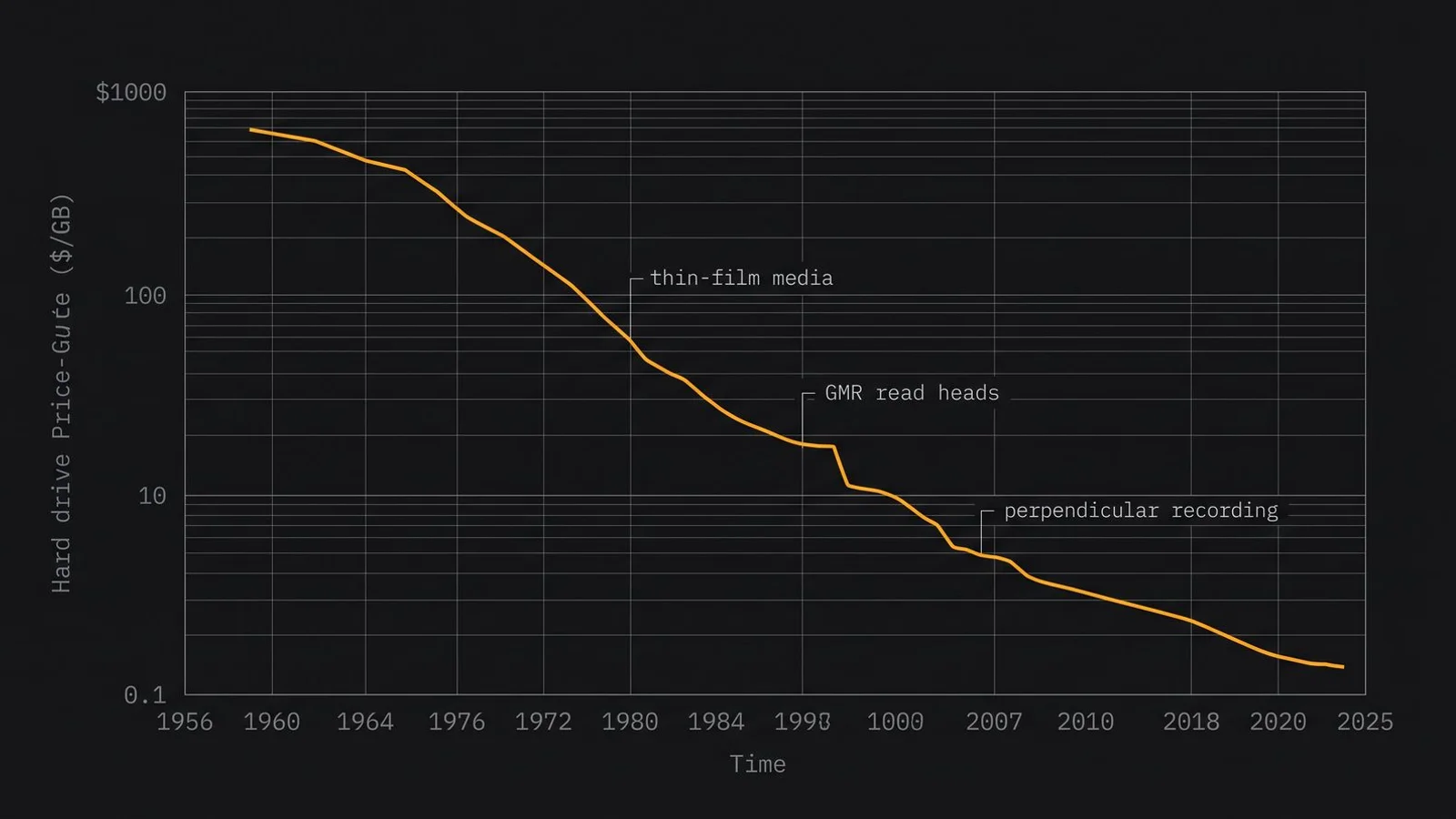
The number that matters is not any single price point but the slope. Areal density on a single platter grew faster than Moore’s Law for about fifteen years, then slowed sharply once perpendicular recording reached its practical limit. That slowdown is where the second arc of this story starts — the displacement.
Where the displacement actually happened
Flash did not kill the hard drive. It displaced it from one specific tier of the storage stack: the boot drive of consumer devices. Look at the unit-shipment data and the substitution is precise. Notebook computers ship almost exclusively with SSDs from 2018 onward. Capacity-tier server storage — the rows of spinning disks in a hyperscaler aisle — kept growing, because cost per terabyte still favoured the spinning platter at high capacity.
This is the part that gets reported as “the death of the hard drive” and it is wrong on the data. The shipped-capacity number tells a different story than the shipped-units number, and both are worth reading next to each other.
A builder’s note
I have moved my own working backups across three storage tiers in twenty years — local spinning disk, then a NAS of spinning disks, then object storage rented from a hyperscaler. The drive did not vanish; the address moved. The question that keeps coming back to me, working on tools that store text and images at scale, is whether the next move is back toward local-attached storage as model weights grow faster than network bandwidth does. That is an opinion, not a sourced claim, and it is labelled as such.
What the comeback looks like
The comeback is not a return to the boot drive. It is the slow consolidation of capacity-tier storage onto a smaller number of physically larger drives — twenty-four and thirty-terabyte units shipping today, with helium-filled enclosures and shingled or microwave-assisted recording extending the curve a little further. The economics still work at scale. They do not work in a laptop. Those are two different products with the same name.
The story ends where it begins: with a price-per-unit-over-decades chart and a question. The price is no longer the constraint. The constraint is what we choose to store now that storing things is almost free.
Sources
- IBM Archives — 350 RAMAC product announcement (1956)
- Bureau of Labor Statistics — CPI Inflation Calculator
- John C. McCallum — Disk drive prices 1955–present
- Western Digital Q4 2025 investor presentation